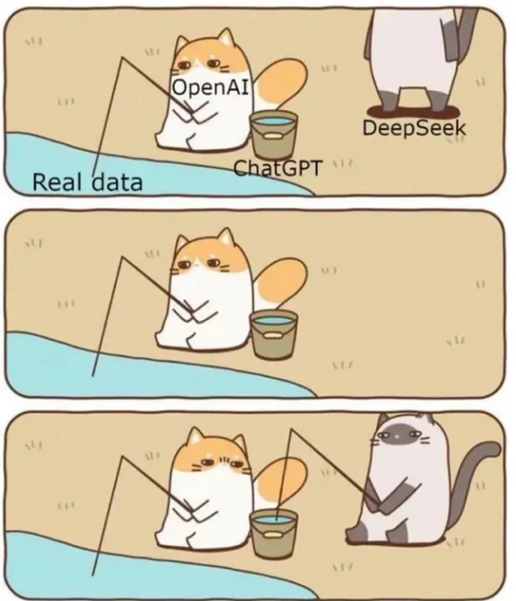



Financial markets are falling, LinkedIn is bursting at the seams and corporate headquarters are buzzing with the sounds of urgent appointments. What is the source of this agitation? A new player has emerged in the language model market - DeepSeek.
What is DeepSeek
DeepSeek is a Chinese company set up to create large-scale language models (LLMs). Its DeepSeek-R1 model shook up the AI world, and the chatbot released based on it overtook ChatGPT to become the most downloaded (free) app in the US App Store. This begs the question: why.
One of the reasons behind this was the data that confirmed that it performs reasoning tasks at the same level as OpenAI's o1 model. Also not insignificant was the reported cost of training this model, which was said to be US$6 million compared to GPT-4's US$100 million (at the time of publication, this information had already been disputed). In my opinion, however, the fact that the solution was published in an open-source model, and therefore completely free, was the most significant factor.
Open-source changes the rules of the game
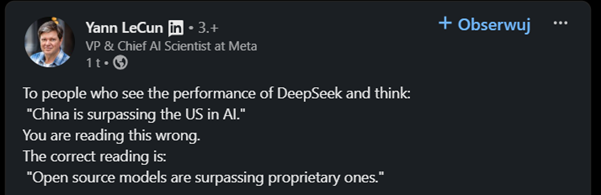
The author of the above opinion is Yann LeCun - VP & Chief AI Scientist at Meta. He shared his thoughts on the X platform and on LinkedIN clearly indicating that open-source is the reason for all the fuss. Had the model been closed, would the reaction have been less intense? Perhaps. But it would not have changed anything in the fact that the rules of the game have been changed and entrepreneurs, investors and professionals have to approach to revise their business strategies and future investments.
It is interesting to note that Yann LeCun in his post, sees the successes of DeepSeek in other open-source solutions i.e. Llama and PyTorch (both coincidentally from Meta ...). However, the open-source model cannot be denied its significant contribution to technology leaps and its key influence in the never-ending cycle of innovation.
What does this mean for me?
If you are just sitting in a big office building, sipping an espresso and thinking to yourself ‘the topic is not for me, corporations don't use open-source’ then you might be wrong. LibreOffice, Mozilla Thunderbird, Ruby on Rails, Kubernetes, PostgreSQL, Terraform - all these tools (and many, many more) are examples of how deeply open-source has seeped into the day-to-day operations of many companies. So let's consider what open-source has to offer.
Advantages of open-source solutions
Reduced financial entry threshold: For many companies, the cost of purchasing a licence for traditional software can be a significant barrier. Open-source offsets this problem, allowing access to advanced tools without requiring a large investment from the outset.
No need to build from scratch: With open-source, we can avoid the need to create everything from scratch. Off-the-shelf solutions allow us to deploy technology and customise it quickly.
Avoiding vendor lock-in: By using open-source, companies are not dependent on a single supplier. This gives flexibility to adapt tools and technology as business needs change.
Benefits of contributions from others: Open-source is a community. It allows you to benefit from the contributions of thousands of users and developers around the world, leading to continuous improvement and innovation.
Eliminate the weaknesses of open-source with the example of RunBotics
Of course, open-source is not a remedy for every situation or a solution for every problem. Like any technology, it has its challenges. The most important thing is to be aware of them and plan for support.
What to look out for in open-source implementations:
Vulnerability to security attacks:
Open-source can be more vulnerable, as the recent attack on DeepSeek shows. It is important to look at who can contribute to the solution when making a decision. Is there a professional partner who is responsible for the solution and does this partner have experience and expertise in security management. One of the pillars of our partner All for One Poland is to take care of information security https://www.all-for-one.pl/pl/oferta/bezpieczenstwo-informacji/ so we know that experience in this area can only help our users and contributors to RunBotics.
Lack of support from the vendor:
The co-creators know the most about the application. If they are employed by a vendor or partner, you can be sure that you will receive reliable support. If open-source does not provide such options you must be ready to commit your own resources and to unexpected twists and turns.
Risk of misjudging total costs:
Although open-source itself is free, the solution itself is not the only cost to consider when introducing a new element into the enterprise ecosystem. If we want to solve a problem with its help, we have to take into account the time commitment of key employees both in implementing the solution, learning how to use it and optimising further maintenance. An experienced partner can provide their knowledge from other implementations, best use cases, ROI calculations.
Time of revolution
The world of new technologies is currently rushing by at an incredible pace, and implementing them seems quite a challenge. However, it looks like waiting for change to ‘settle down’ is not a good idea and can lead to significant delays and loss of competitiveness. The revolution is already happening, and companies that take advantage of it today will be in a better position to meet the demands of tomorrow. It is time to act!